Why quoting is the most expensive job in your workshop
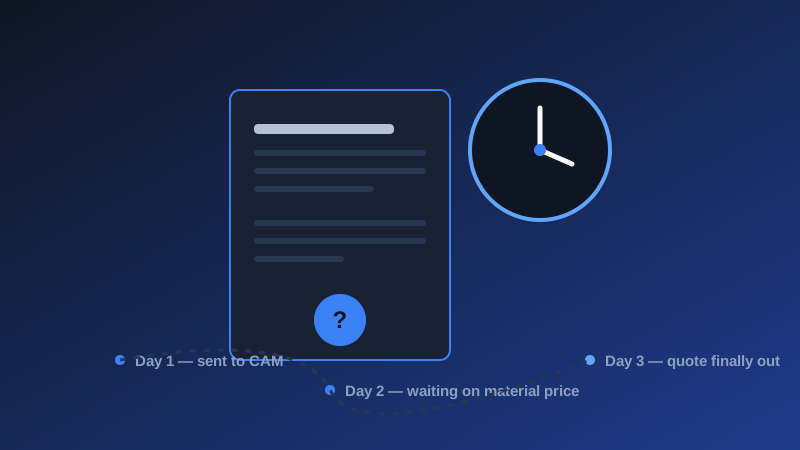
Quoting feels free. No material gets cut, no machine runs, nobody clocks hours against a job number — so it rarely shows up as a cost on anyone's books. And yet, in most CNC and laser shops, quoting is one of the most expensive things that happens all week. The cost just hides better than a bag of offcuts.
It hides in the form of jobs you never even got to bid on. Industry observers who work closely with fabrication shops describe a consistent pattern: the shop that responds quickly wins work that slower competitors never get a chance to bid on. For small and mid-size jobs in particular, speed of response often matters more than being a few percent cheaper — a customer under time pressure commits to whoever answers first, not whoever eventually sends the lowest number.
The six things that actually slow a quote down
When you trace why a quote takes three days instead of three hours, the same bottlenecks show up again and again in shop-floor discussions:
- Owner dependency — the one person who prices jobs is also running production, so quoting happens at 9pm.
- Key-person pricing knowledge — the logic for pricing a job lives in someone's head, not in a system, so it can't run without them.
- The CAM bottleneck — getting an accurate machine-time estimate means waiting for time on the CAM workstation.
- Material pricing delays — anything outside standard stock means a phone call to a supplier before a number can go out.
- Drawing quality — unclear dimensions mean a round trip to the customer before pricing can even start.
- Quote backlog — once the queue builds up, every new request waits behind the last one, and the delay compounds on itself.
None of these are really about the price of steel or the cost of running a laser for six minutes. They're about how many people, systems, and phone calls have to line up before a number can be typed into an email. That's a workflow problem, not a pricing problem — and it's exactly why fixing it does not require hiring an estimator, only removing the steps that don't need a human at all.
What a same-day quote actually requires
A shop that quotes in minutes instead of days has usually done one thing: it moved the pricing logic out of one person's head and out of a CAM queue, and into a system that already knows the shop's material costs, machine rates, and cutting parameters. That's the whole premise behind CPQ 4 CNC — it computes a real, defensible number from your actual machine time and material data the moment a part is uploaded, so the quote doesn't have to wait for the one person, the one workstation, or the one supplier call that's currently the bottleneck.
The jobs you lose to a faster competitor never show up on a report. That's what makes this the most expensive line item nobody tracks.