Offcuts aren't scrap — they're inventory you're not tracking
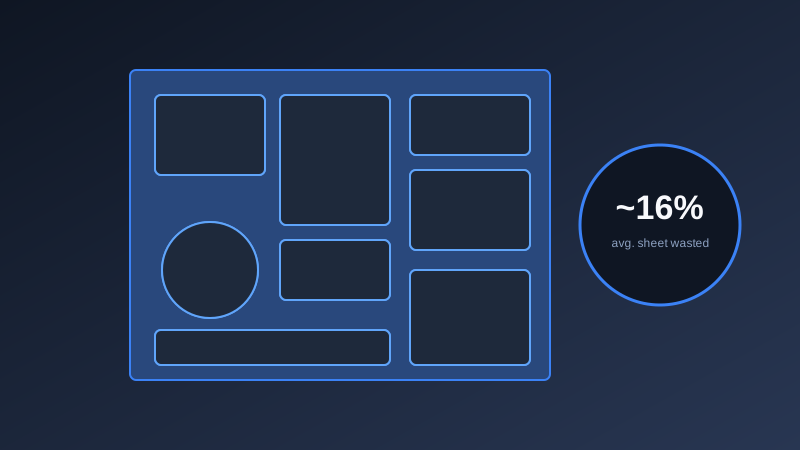
Walk past the rack at the back of most fabrication shops and you'll find a pile of sheet offcuts nobody has counted in months. Officially, it's scrap. In practice, it's raw material that was already paid for — and if industry figures on sheet-based fabrication are anything to go by, there's more of it than anyone would guess.
Case studies on sheet metal production put average raw material waste at roughly 15 to 16% of the sheet. The cause is not carelessness — it's geometry. Parts get nested onto a rectangular sheet while leaving clearance for the machine's grippers, and whatever is left over forms a "skeleton" around the parts that can't be cut into anything else and gets disposed of. One documented case, a sheet metal manufacturer that shifted a handful of product lines from sheet-fed to coil-fed production, cut waste down to 2–3% and saved the equivalent of tens of tonnes of material a year in the process — by removing exactly that clearance constraint.
Most workshops can't switch their whole production to coil-fed machinery just to fix this — that's a capital decision, not a software one. But the 15–16% figure isn't destiny either; it's what happens when nesting is done loosely and offcuts are written off the moment a job finishes, instead of being logged, measured, and considered for the next job that happens to need a smaller piece of the same material and thickness.
Two different problems, easy to confuse
There are really two separate levers here, and they get solved differently:
- Nesting efficiency — how tightly parts are packed onto a new sheet before it's ever cut. This is a per-job optimization problem.
- Offcut inventory — what happens to the material left over after cutting. This is a tracking problem: if nobody records that a 400×600mm offcut of 3mm aluminum exists on the rack, it will never get used, no matter how good the nesting was on the job that produced it.
Most generic ERP systems have no concept of either one — they track finished-goods inventory by part number and quantity, not irregular leftover shapes by material, thickness, and size. That's a reasonable gap for a system built for assembling purchased components; it's a real cost for a shop whose raw material comes in sheets.
Treating the rack like real inventory
ERP 4 CNC logs every offcut generated by a completed job — material, thickness, and dimensions — so the next quote can check whether an existing offcut covers the part before pulling a fresh, full-price sheet. It doesn't eliminate the geometry problem behind that 16% figure, but it stops writing off the material that survives it.