How to actually calculate a laser cutting quote
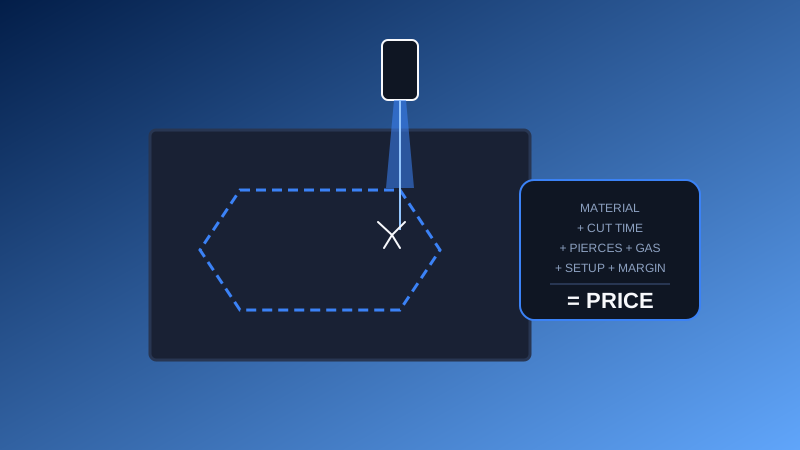
"Just charge by the minute" is how a lot of shops price a laser cutting job — and it is also how a lot of shops quietly lose money on the jobs that should have been their most profitable ones. A real quote is not one number, it's seven, added together. Skip one of them consistently and it shows up months later as margin that never quite adds up.
The seven components of a real quote
- Material — sheet price divided by parts per sheet, adjusted for the offcut you can't reuse.
- Cutting time — total cut length divided by the cutting speed for that material and thickness, multiplied by the machine's hourly rate.
- Pierces — every hole or feature start costs pierce time; count them and multiply by the hourly rate.
- Assist gas — cutting time × flow rate × gas price. Easy to forget, rarely negligible on thicker material.
- Rapid traverse — the head still has to move between cuts, and that time is often left out of simplified estimates entirely.
- Setup — programming and load/unload time, amortized across the quantity in the batch.
- Margin — applied on top of the true cost, not guessed at the end because the number "feels low."
The machine's hourly rate itself is not one flat number either — it should already bake in depreciation, power draw, maintenance, the operator's time, and a share of facility overhead. Depending on power and age, a modern fiber laser's fully-loaded hourly rate commonly falls somewhere between roughly $80 and $180 per hour — a shop that quotes off a rate picked five years ago is quoting off the wrong number today.
A worked example
Take a 10mm mild steel bracket, 25 pieces, 8 pierces per part. Adding up all seven components looks like this, per part:
Notice where the money actually is: material accounts for roughly 64% of the total cost on this part, while cutting time is only about 7%. A shop that prices mainly "by the minute" and treats material as an afterthought is optimizing the smallest number on the list. And acceleration/deceleration — the machine slowing down and speeding back up around every corner — is routinely left out of simplified estimates, even though it can add 30–40% to the cutting-time line on geometrically complex parts.
Why this is hard to do by hand, every time, for every part
None of this math is exotic — it's just seven numbers that have to be recalculated correctly for every single part, every single time, which is exactly the kind of task that degrades under deadline pressure. CPQ 4 CNC runs this same seven-part calculation automatically from your material profiles and machine rates the moment a DXF or SVG is uploaded, so the quote that goes out the door is the same one you'd get if you had an hour and a calculator — except it takes under a minute.
Further reading